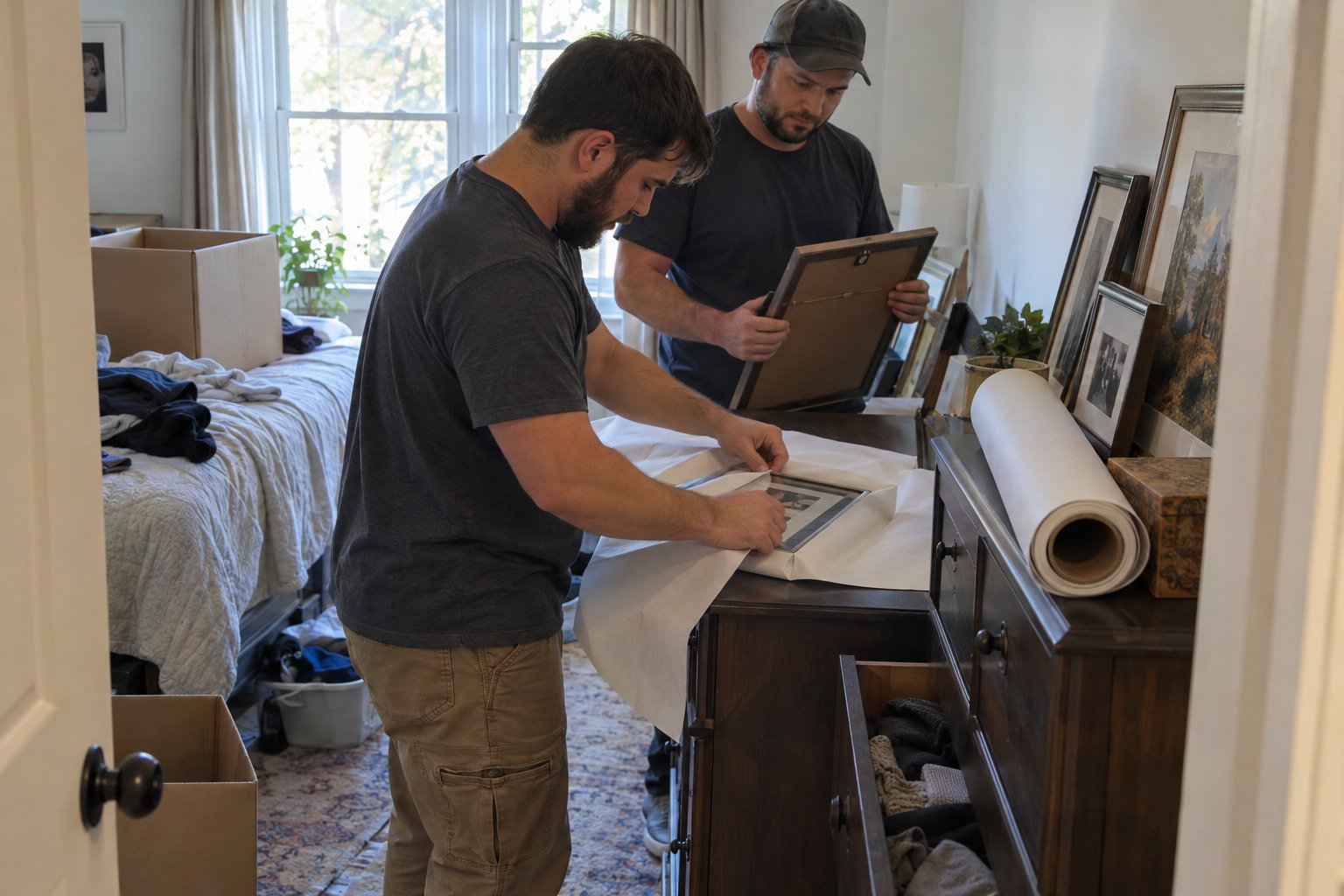
Learning how to pack picture frames for moving comes down to three things: keeping the glass from flexing, keeping the corners from taking an impact, and keeping pieces from rubbing against each other during transit. Frames are an odd category of fragile item. They are flat and seem easy to stack, but that flatness is exactly what makes them vulnerable: a single bump to a corner or a few pounds of pressure across the center of the glass is enough to crack it. A little method turns a box of frames from a liability into one of the easiest parts of the move.
Picture frames break because their weakest points, the glass pane and the corner joints, are also the points most likely to take direct pressure when boxes shift or get stacked wrong. Flat items tempt people into leaning them against a wall unprotected or sliding several into one box with nothing between them, and that is when scratches, cracked glass, and loosened corners happen.
Unlike furniture, a frame has almost no give. There is no cushioning built into the object itself, so every bit of protection has to come from what you wrap around it. Glass is also more likely to crack under a sudden shock, like a box being dropped a few inches, than under steady pressure, which is why how you stack and secure frames in the truck matters as much as how you wrap them. If you are already arranging professional packing services for the rest of the home, flag framed items separately so the crew knows to box them on their own rather than folding them into general boxes.
You need picture-frame boxes (or flat mirror boxes) in a couple of sizes, packing paper, bubble wrap, painter's tape, and cardboard corner protectors. Skipping any one of these usually shows up as a scratch, a dent, or a crack when the frame comes out of the box at the new place.
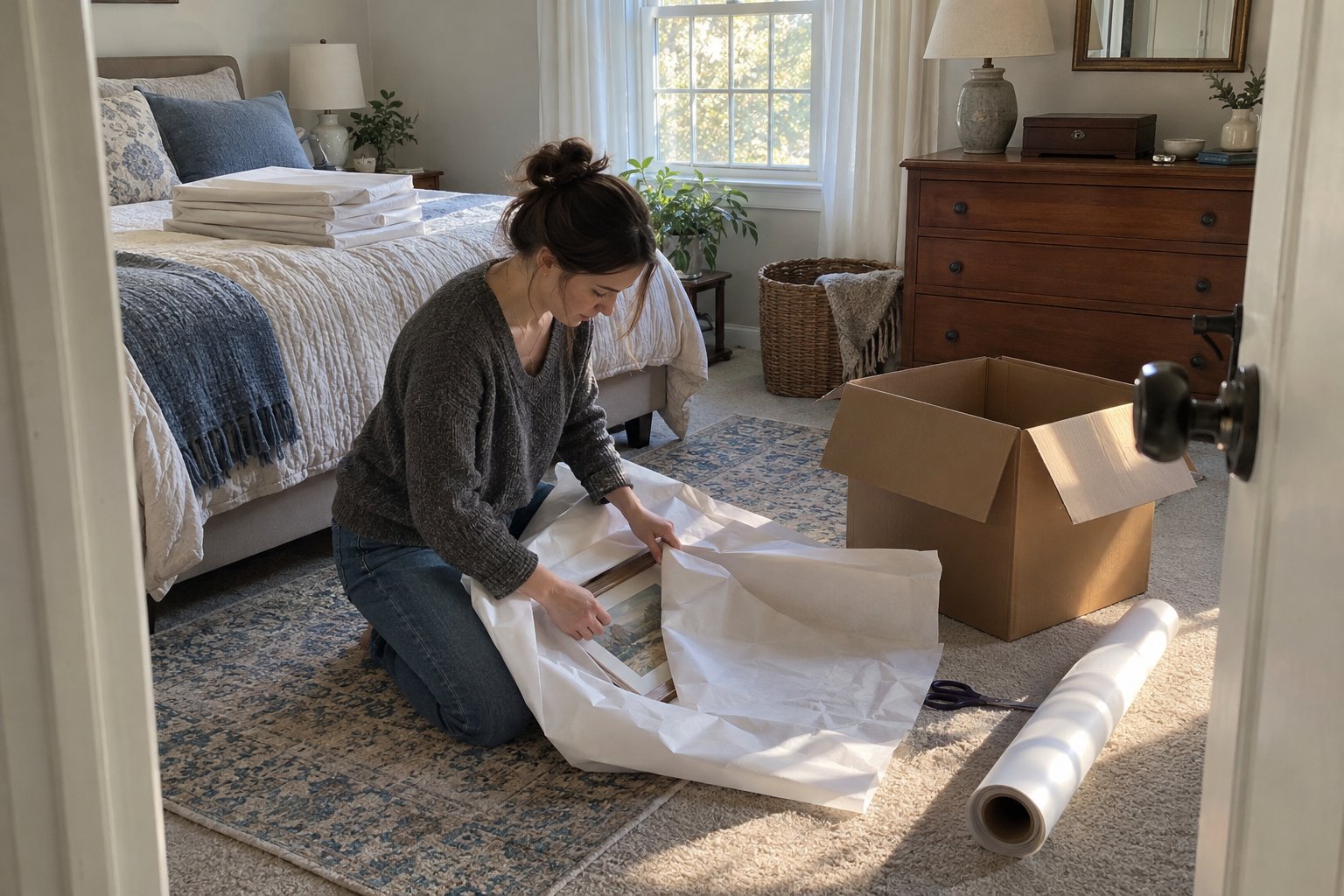
Tape an X across the glass, wrap the frame in packing paper, add corner protectors, then wrap the whole thing in bubble wrap before boxing it upright. The tape keeps shattered glass from scattering if it does crack, and everything after that is about absorbing shock before it reaches the glass.
Stand frames on edge with a sheet of cardboard between each one and group similar sizes together so smaller pieces are not swimming around a box sized for something much larger. Fill empty space with crumpled paper so nothing can tip sideways once the box is moving. The same divider logic applies to other flat, breakable items, so if you are also boxing up framed collectibles or glass shelving from a home office, carry it over there too.
Canvas prints, framed posters without glass, and mixed-media pieces still need corner protection and a rigid outer layer, but they are more forgiving about surface contact since there is no glass pane to crack. The main risk with canvas is puncture or a dent to the painted surface, not shattering.
Wrap canvas art in a layer of packing paper to prevent scuffing, then cover it with a sheet of cardboard cut slightly larger than the piece on each side (a "sandwich" of cardboard front and back), taped at the edges. This keeps a stray box corner or shifting item from poking through the canvas. For anything with raised texture, such as a textured painting, avoid letting tape or plastic touch the surface directly.
Very large frames or art that does not fit a standard picture box usually need a custom cardboard crate built on the spot, with foam or paper padding along every edge. Heirloom portraits and older framed pieces sometimes have fragile backing paper or aged frame joints that add another layer of risk; the same caution applies to other heirlooms and antiques that need more than standard wrapping. If you are unsure whether a piece will survive standard packing, that is a sign to ask about art moving services rather than improvise.
Frames belong upright, wedged between soft items, and loaded last so they come off first and are never buried under furniture. Treat them the way you would treat something you genuinely cannot replace, because in the case of family photos and original art, you often cannot.
Avoid stacking anything heavy on top of a frame box, even one marked fragile, since boxes shift during transit and labels do not stop weight from pressing down. A gap between a mattress and a wall, or a slot in a closet-style section of the truck, works well because frames are protected on both sides without anything resting directly on top of them. If frame boxes are just one part of a larger load, a free moving quote is the easiest way to find out whether full packing support makes sense for your move.
A regular box will not protect a frame as well as a picture-frame or mirror box, which telescopes to fit snugly and keeps the frame from flexing. If you only have standard boxes, reinforce the bottom with extra tape and never let a frame lie flat under other items.
Tape an X across the glass, wrap the frame in packing paper, add corner protectors, then add a full layer of bubble wrap before placing it upright in a snug box. The corner protectors and upright positioning do the most to prevent cracks.
It is better to pack frames standing on edge rather than flat. Lying flat, a frame can bow under the weight of anything stacked on top, and glass is more prone to cracking under sustained pressure across its center.
That depends on the box size and frame dimensions, but a good rule is to group similarly sized frames together with cardboard dividers between each one, leaving no empty space for them to shift or tip.
Wrap the canvas in packing paper to prevent scuffing, then sandwich it between two pieces of cardboard cut slightly larger than the piece and tape the edges. For anything oversized or especially valuable, professional wrapping is worth considering.