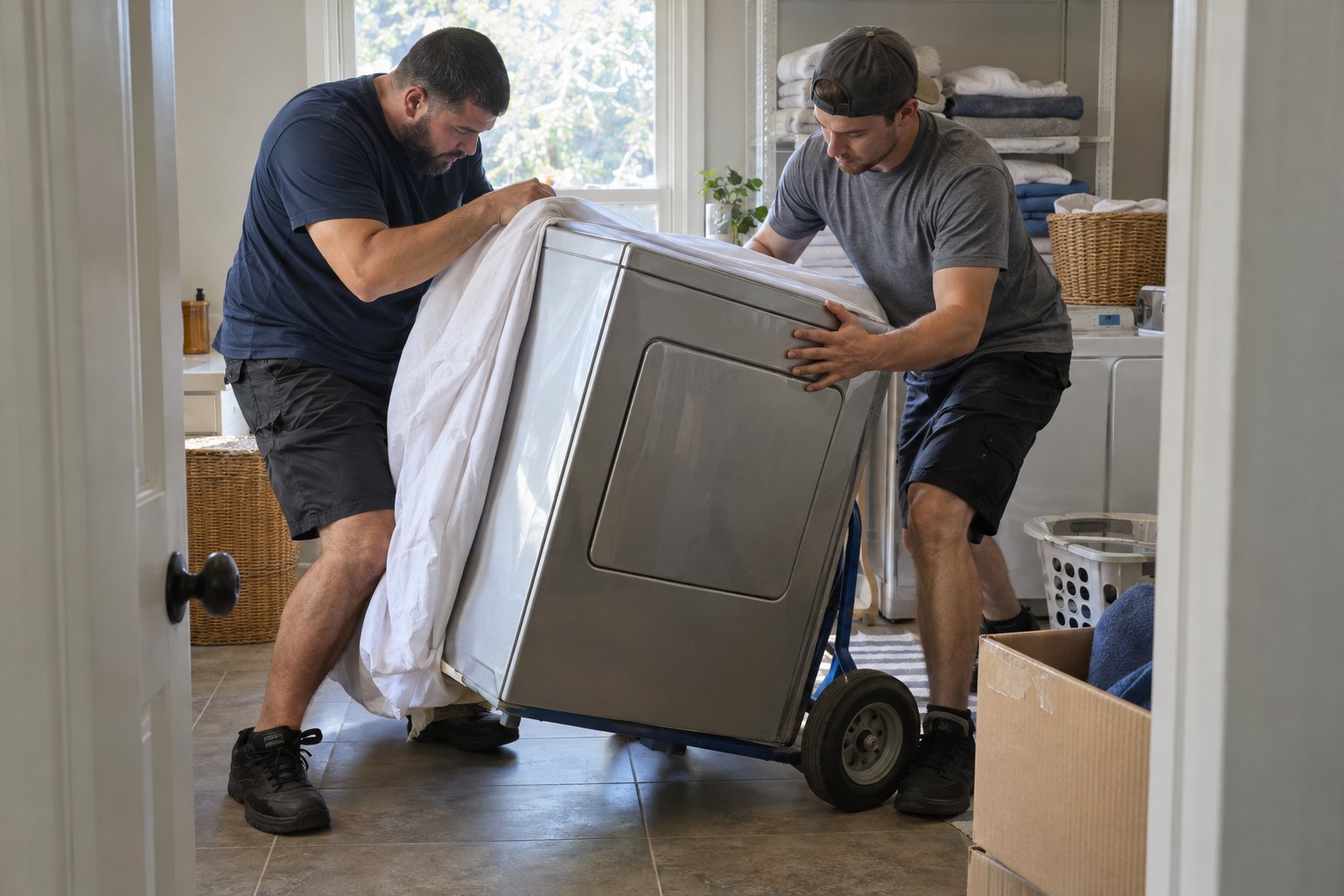
Moving a dryer and moving a chest freezer both involve heavy, boxy appliances that are awkward on stairs, but the prep work is not the same. A dryer mostly needs disconnecting and securing the drum, while a chest freezer needs a decision about defrosting that can affect your whole moving day timeline. Knowing where these two jobs overlap and where they diverge keeps you from applying the wrong checklist to the wrong appliance.
A dryer is lighter, simpler to disconnect, and rarely needs advance planning beyond unhooking the vent and power. A chest freezer is heavier for its size, holds food that needs a plan, and can take a day or more of lead time if you choose to defrost it first. Both need two people and a dolly built for appliances, but the freezer adds a timing decision the dryer does not.
For a dryer, disconnection is usually a five-minute job: unplug it (or shut off the gas valve and disconnect the gas line if it is a gas dryer), detach the vent hose, and tape the hose out of the way so it does not catch on a doorway. For a chest freezer, disconnection is about more than the power cord. You need to decide in advance whether to let it run until moving day or shut it down early, because that decision drives what happens to the food inside and how much moisture the compressor has had time to settle.
A standard dryer is manageable for two people with an appliance dolly, especially once the vent and any mounting brackets are clear. A chest freezer, even empty, sits low to the ground and is harder to get leverage on, and a loaded one is heavier still. If yours is not empty by moving day, expect it to take more hands or a flatter hand truck to control safely on a ramp.
Yes, for a short trip you can often move a chest freezer without a full defrost, as long as it is unplugged a few hours ahead so condensation has time to settle and the door is secured shut for transport. For a longer haul or an interstate move, defrosting first is the safer choice because it reduces weight, removes the risk of melting food leaking into the cabinet, and gives the unit time to reach room temperature before it is tipped or laid on its side.
As a rule of thumb, plan for about a day of lead time if you intend to defrost and dry the interior completely before loading day. That gives condensation a chance to evaporate and lets you towel out any remaining moisture before the doors are taped shut.
If you don't have a full day to spare, unplug the freezer as early as you can, remove any food that might spoil or shift during transport, and prop the lid slightly before closing it fully, just long enough to let trapped humidity escape. Pack towels around the base of the interior to absorb any condensation that forms in transit.
The chest freezer needs more lead time because of the food and moisture question; the dryer needs almost none beyond confirming your gas line is safely capped if applicable. If you are moving both appliances on the same day, plan the freezer's shutdown timing first and treat the dryer's disconnection as a same-morning task.
For a gas dryer specifically, if you are not confident shutting off and capping the gas line yourself, it is worth asking a technician or your utility provider to do it ahead of your move date rather than attempting it on the morning of.
A dryer is a reasonable DIY job for two able-bodied adults with a dolly, since it is lighter and the disconnection steps are quick. A loaded or poorly-drained chest freezer is where more people lean on professional movers, since the combination of weight, low clearance, and the risk of a moisture leak onto flooring makes it less forgiving of a wrong grip or a rushed tilt.
If your route to the truck includes a narrow hallway, a tight stairwell, or an uneven driveway, both appliances benefit from a second set of hands checking clearance before you start carrying. Our local moving crews handle large appliances as part of a standard move, so if either job feels like more than your household can manage safely, that is a reasonable point to bring in help rather than risk the appliance or your floors.
For most local moves, unplug the dryer the morning of and disconnect the freezer the night before, giving it enough time to drain and dry. This split keeps the dryer task simple and gives the freezer the lead time it actually needs without tying up your whole prep schedule. If your move is long-distance or the freezer is older, lean toward a full defrost rather than a quick unplug, since a leak inside a moving truck is harder to deal with mid-transit than one in your own kitchen.
If you're relocating out of the area entirely, our long distance moving team can advise on timing both appliances around a multi-day transit schedule. For general guidance on handling heavy items safely, OSHA's ergonomics guidance on safe lifting is a useful reference before anyone attempts either appliance alone.
If you are moving from a home in Opelika, AL or a home in Auburn, AL, the same checklist applies either way since the appliances themselves, not the address, determine the prep work.
Planning your move? Request a quote from Wise Guys Moving.

If you are not confident doing it safely, ask a technician or your gas utility to shut off and cap the line ahead of moving day instead of attempting it yourself that morning.
Unplugging it the night before gives condensation time to settle and the interior time to dry, though a shorter window of a few hours can work if you towel-dry the inside before closing it.
It's best kept upright whenever your doorways and truck layout allow it. If it must be tilted briefly to clear a tight space, keep that time as short as possible and return it to upright as soon as you can.
Let them know whether the dryer is gas or electric and whether the freezer has been defrosted, so the crew can plan the right equipment and handling for each appliance.
For a short local trip it can be manageable if the food is secured and unlikely to shift, but for anything longer it's safer to remove perishables first so a leak or spoilage isn't a risk in transit.